
How AI Can Capture Motion and Style Through Watercolor
Artificial intelligence is becoming a creative tool that can replicate artistic styles and capture movement in ways that used to take years of practice. For this project, I wanted to see if AI could generate a watercolor painting that felt natural and expressive. I wanted something that looked hand painted but still showed athletic motion.
I chose a subject that connects to what I enjoy most, mountain biking. I ride a 2005 Specialized Stumpjumper, and I wanted the AI to create an image of a rider descending a rugged trail in a realistic, athletic position. My goal was to combine the energy of downhill riding with the softness and unpredictability of watercolor art.
The result surprised me. The AI captured the motion of the rider and the texture of watercolor brush strokes better than I expected. The smoke colors, red, gray, and blue, blended into the forest background and gave the image a rustic, misty atmosphere. It looked like something that could hang in a cabin or be used as a poster for an outdoor event.
AI tools like this show how technology can support creativity instead of replacing it. They allow people to experiment with styles, colors, and composition without needing to master every technique. Still, AI does not truly understand art. It learns patterns from data. The human part is deciding what looks right, what feels authentic, and what tells a story.
Find out more about our work below.
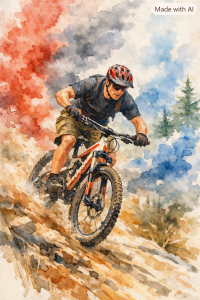 Your water color mountian bike man .
About the AI Image
Prompt Development My original prompt asked for a watercolor painting of a six foot man riding a mountain bike downhill with rustic colors and smoke effects. The first result looked interesting, but the bike was not accurate and the pose did not look athletic enough. I revised the prompt to include my actual bike, a 2005 Specialized Stumpjumper, and added details like the aggressive downhill riding position and the rustic red, gray, and blue smoke colors. For the final prompt, I added a misty mountain forest, clearer bike details, and emphasized watercolor brush strokes. This made the final image look more realistic and closer to what I wanted.
Prompts Used
-
Original Prompt: A watercolor painting of a six foot athletic man riding a mountain bike downhill on a forest trail. Rustic colors with red smoke, gray smoke, and blue smoke blending in the background.
-
Revised Prompt: A watercolor painting of a six foot athletic white male riding a 2005 Specialized Stumpjumper downhill in an aggressive, athletic position. The background includes rustic tones with red, gray, and blue smoke drifting through a forested mountain trail.
-
Final Prompt: A detailed watercolor painting of a six foot athletic white male riding a 2005 Specialized Stumpjumper downhill in a dynamic, forward leaning position. The scene uses rustic colors with red smoke, gray smoke, and blue smoke blending into a misty mountain forest. The bike’s frame, suspension, and wheels are clearly defined, and the watercolor texture is visible in the brush strokes and color gradients.
Following Instructions The AI understood the watercolor style well and produced images with strong color blending. It struggled with bike accuracy and rider anatomy at first, especially the downhill posture. After refining the prompt, the final image followed my instructions much better. The bike looked closer to a real Stumpjumper, and the rustic smoke colors blended nicely into the forest background.
Usefulness AI generated images like this can help organizations create custom artwork, marketing visuals, or concept illustrations without needing a full art team. They can also help designers explore styles like watercolor, oil painting, or digital illustration quickly.
Concerns and Disadvantages Organizations should consider copyright rules, licensing, and whether the AI tool allows commercial use. AI images can also contain mistakes that look believable, especially with anatomy, equipment, or perspective. Generating images requires large data centers that use energy, water, and physical infrastructure. AI tools can also affect traditional artists by replacing some types of commissioned work.
Misinformation Realistic AI images can be used to create fake events or misleading scenes. Someone could generate an image of a person doing something they never did. Before trusting an image online, people should check the source, look for inconsistencies, and verify whether it came from a reliable organization.
Your Evaluation If this were for a real organization, I would use the final image. It fits the topic, looks visually appealing, and matches the watercolor style I wanted. I would still double check details before using it professionally.
AI Disclosure I used ChatGPT Images to generate the artwork.